
Namibia travel · NamSpace
Etosha for First-Timers: Best Months, Gates, Waterholes, How Many Days & Where to Stay
Plan your first Etosha visit around gates, bases, waterholes and enough time to pause.
As an Amazon Associate I earn from qualifying purchases. This article contains optional Amazon links. Check delivery and the full cost before buying.
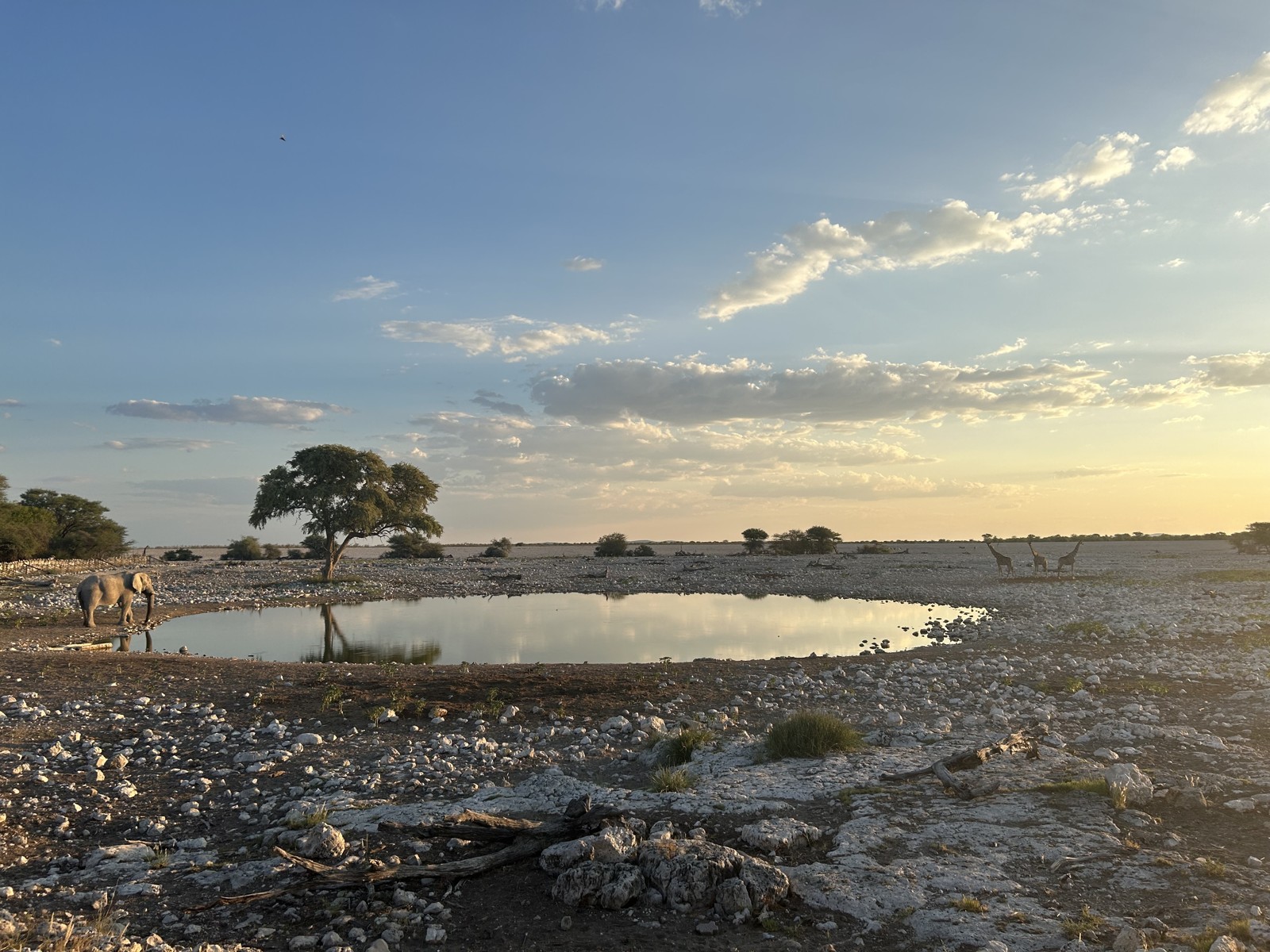
Image credit & rights
Waterhole Okaukuejo Camp in Etosha National Park.jpg — Hka1987, via Wikimedia Commons. CC0 1.0. Source: https://commons.wikimedia.org/wiki/File:Waterhole_Okaukuejo_Camp_in_Etosha_National_Park.jpg. Licence: https://creativecommons.org/publicdomain/zero/1.0/. Resized for web; no scene content changed.

Etosha is easy to underestimate on a map.
You see the pan. You see a road through the park. You see a few rest camps. It can look like somewhere you drive into in the morning, collect some wildlife sightings and leave by evening.
That is not the Etosha trip I would recommend.
Etosha National Park covers about 22,935 km². Its salt pan dominates the landscape, but the wildlife experience comes from the wider grasslands, mopane, woodland and — especially in the dry season — the network of natural and artificial waterholes that concentrate animals across the park.
For a first visit, the most useful decisions are not “Where are the lions?” or “Which waterhole guarantees elephants?”
They are:
- What month are you visiting?
- Which gate fits your route?
- Which part of the park should you sleep near?
- How many full game-viewing days do you actually have?
- Are you willing to sit still long enough for wildlife to come to you?
Etosha in one minute
- Best general game-viewing period: May to October.
- Rainy season: greener, more dispersed wildlife and stronger birding.
- Main public gates: Andersson, Von Lindequist, Galton and King Nehale.
- Gates generally open at sunrise and close at sunset.
- Park permits can be issued on arrival at park gates.
- Inside-park accommodation includes Okaukuejo, Halali, Namutoni, Dolomite, Onkoshi and camping options such as Olifantsrus.
- Okaukuejo, Halali and Namutoni have floodlit camp waterholes.
- For a first self-drive visit, two nights is the minimum I would consider; three to four nights is much better.
Best time to visit Etosha
May to October — strongest general wildlife viewing
This is the classic Etosha season.
As the dry season develops, natural water becomes scarcer and wildlife increasingly concentrates around reliable waterholes. Namibia Tourism Board specifically identifies May to October as Etosha’s strongest general game-viewing period.
May and June can still carry some remaining vegetation from the rains and winter mornings become colder.
July and August are dry, popular and excellent for classic waterhole viewing.
September and October can be especially intense around water as dryness deepens, but temperatures begin climbing again.
November to April — greener Etosha and stronger birding
The rainy season changes the park.
Animals can disperse because water is more widely available, so the classic “sit at one waterhole and wait” strategy can become less predictable.
But the landscape changes, birding improves and seasonal pans can attract large numbers of birds when rainfall is favourable.
If your goal is not only mammals, do not treat green-season Etosha as the bad version of the park.
It is a different version.
How many days do you need?
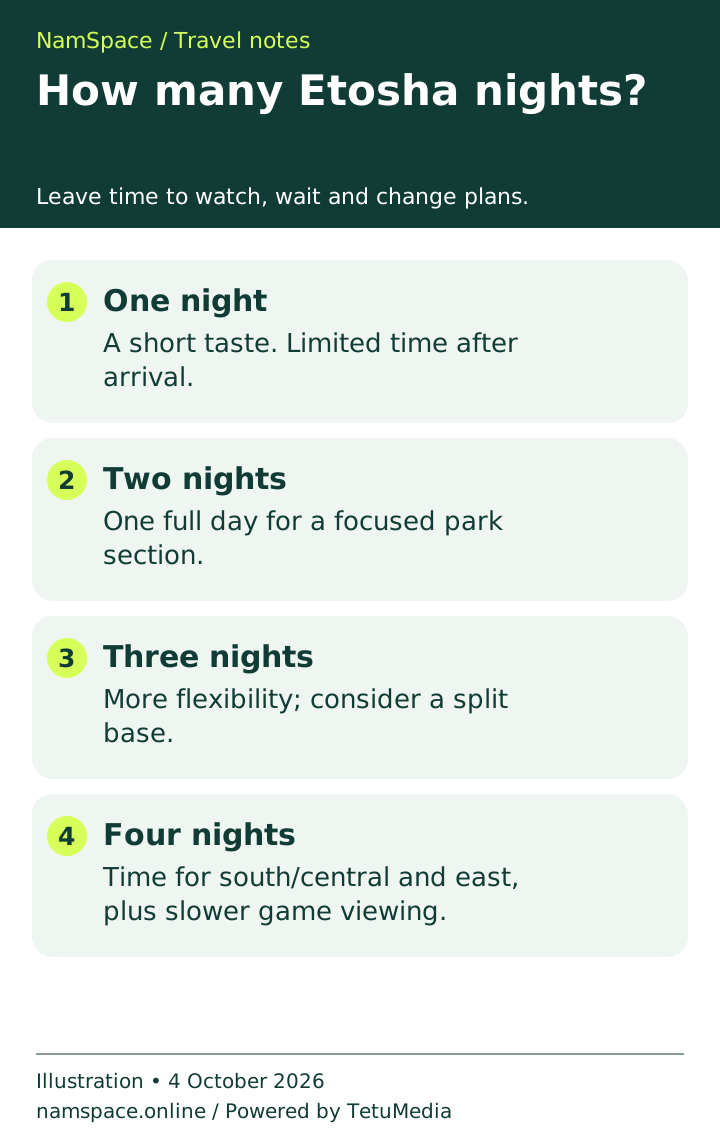
Image credit & rights
Illustration: NamSpace. Powered by TetuMedia.
One night
Possible, but rushed.
You may get one afternoon drive and one morning drive. If wildlife is quiet during those windows, that is your entire Etosha experience.
Two nights
The minimum I would recommend for a first visit.
This gives you at least one full day plus arrival/departure game viewing.
Three nights
A strong first-timer choice.
You can explore more than one area without turning every day into a relocation.
Four nights
My preferred choice in a two-week Namibia road trip.
This gives you enough time to split your stay between park sections, move slowly, repeat productive waterholes and absorb one quiet day without feeling that the safari failed.
Five nights or more
Worth it if wildlife and photography are major reasons for the trip.
Etosha rewards repetition.
The waterhole that looked empty yesterday may be the best place in the park today.
Which Etosha gate should you use?
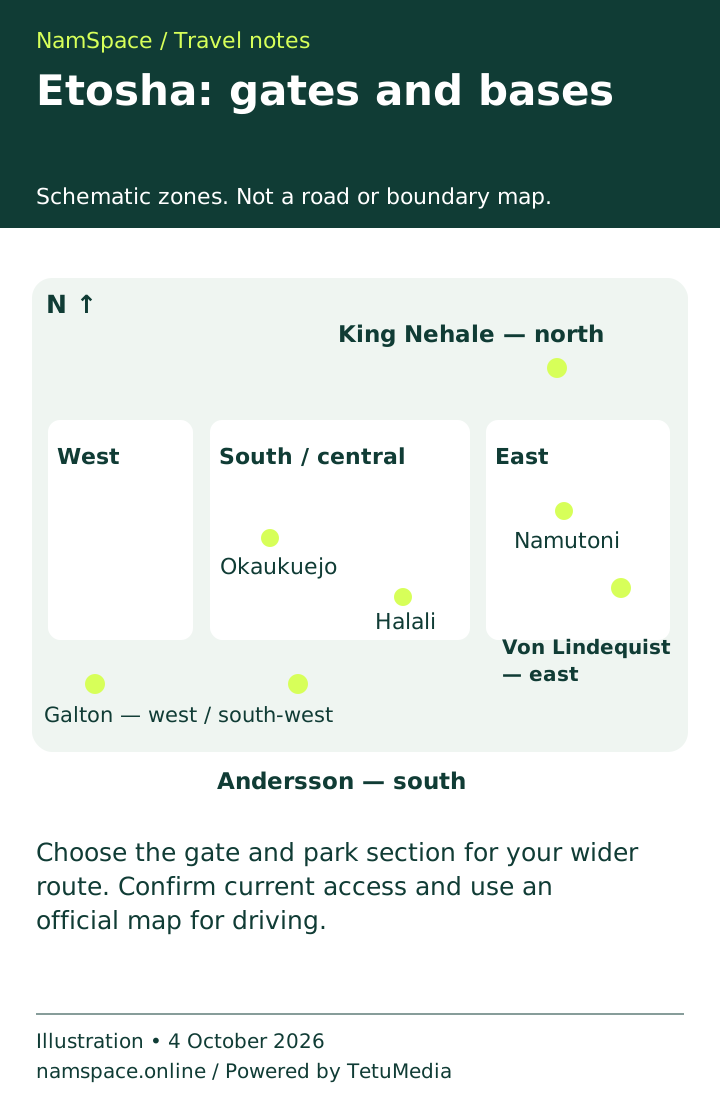
Image credit & rights
Illustration: NamSpace. Powered by TetuMedia.
Andersson Gate — south
The most natural choice for many classic first-time itineraries coming from Windhoek, Outjo or the south/central route network.
Okaukuejo lies about 17 km inside the park from the southern entrance, which makes the south side particularly easy to understand for a first visit.
Von Lindequist Gate — east
The eastern gate is the natural access point for Namutoni and travellers coming from Tsumeb or continuing toward north-eastern Namibia.
If your route continues to Rundu, Divundu or Zambezi, exiting Etosha on the east can make much more sense than driving back to the south.
Galton Gate — west / south-west
Galton gives access to the quieter western side of Etosha and connects toward Kamanjab and the north-western route network.
Namibia Tourism Board describes the Galton–Okaukuejo route as roughly 190 km and highlights dry-season wildlife around western waterholes.
Use this gate deliberately rather than simply because it appears closest on the map.
King Nehale Gate — north
King Nehale connects Etosha with Namibia’s populous north-central regions and makes it possible to combine the park more naturally with Ongwediva, Oshakati, Ondangwa and wider Owambo travel.
It is especially useful if Etosha forms part of a north-central Namibia itinerary rather than the classic Windhoek–Etosha circuit.
Do not choose your accommodation before choosing your gate
This is one of the most important Etosha rules.
“Near Etosha” is not specific enough.
A property outside one gate can be completely wrong for the section you want to explore.
Choose in this order:
- Your route into and out of the park.
- The park section you want to explore.
- Inside or outside the park.
- Individual accommodation.
Inside the park or outside?
Stay inside if you value
- being positioned within the park at the start and end of the day;
- camp waterholes after normal driving hours;
- simpler multi-day movement across the park;
- guided drives offered from the rest camps; and
- reducing the daily gate commute.
NWR and MEFT list Okaukuejo, Halali and Namutoni among the main park camps, with Dolomite and Onkoshi serving other parts of the park. Olifantsrus provides camping in western Etosha.
Stay outside if you value
- more accommodation choice;
- different price points;
- boutique or private-lodge environments;
- amenities not available at the park camps; or
- a base that fits the route before or after Etosha.
The trade-off is the gate.
If you sleep outside, every game-viewing day starts by reaching the gate, completing entry formalities and then driving into the actual wildlife area.
That may be perfectly worthwhile.
Just calculate it honestly.
The three easiest first-timer bases to understand
Okaukuejo — south / central-west
Okaukuejo is the classic first Etosha base.
NWR describes it as 17 km from the southern entrance and its floodlit waterhole is one of the park’s defining wildlife experiences.
It works particularly well if you enter through Andersson Gate and want easy access to the south-central and western waterhole circuits.
The camp offers rooms, chalets, camping, restaurant, shop, fuel, swimming pool and guided drives.
Halali — central
Halali sits deeper inside the park among mopane and dolomite hills.
Its location makes it useful for breaking the park into sections instead of repeatedly returning to the south.
The camp also has a floodlit waterhole and guided morning, afternoon and night drives.
For a three- or four-night trip, one night or more around Halali can make the route feel much less repetitive.
Namutoni — east
Namutoni makes sense for the eastern waterholes and for travellers entering or leaving through Von Lindequist Gate.
It also gives a logical eastern base if your next destination is Tsumeb or the Kavango/Zambezi direction.
The camp includes rooms/chalets, camping, food facilities, a swimming pool and a floodlit waterhole.
What about western Etosha?
The western section is quieter and works particularly well for travellers who deliberately want to enter via Galton or extend beyond the standard south-central-east circuit.
Dolomite Camp and Olifantsrus sit in this broader western experience, and the Galton–Okaukuejo corridor opens a different part of the park from the classic Andersson–Namutoni route.
Do not add the west simply to make the map look complete.
It adds distance.
Add it because you have the nights to enjoy it.
How should you think about Etosha’s waterholes?
Do not build the entire trip around a list titled “the ten waterholes where you will see lions.”
Wildlife does not work that way.
A waterhole can be extraordinary one morning and quiet a few hours later.
Season, temperature, rainfall, predators, wind, other animals and simple chance all matter.
Use waterholes as a network.
Camp waterholes
Okaukuejo, Halali and Namutoni have floodlit waterholes associated with their camps.
That gives guests a completely different rhythm from normal self-driving: you can finish the vehicle-based game drive and still sit quietly watching the water after dark from within the camp environment.
Okaukuejo is the best-known of these, with official MEFT and NWR material specifically highlighting sightings of black rhino, elephant and lion there.
Day-drive waterholes
Across the park, popular named waterholes include places such as Okondeka, Nebrownii, Gemsbokvlakte, Goas, Chudop, Klein Namutoni, Rietfontein, Olifantsbad and others.
Treat them as places to check — not appointments with specific animals.
The correct strategy is often:
- choose a manageable circuit;
- stop at several waterholes;
- note which ones are active;
- return later to promising locations; and
- sit longer when the situation feels right.
The underrated skill: waiting
People can drive past an empty waterhole after three minutes and then complain that Etosha has no animals.
Sometimes leaving is the right decision.
Sometimes the entire safari changes because you waited another twenty minutes.
Watch the behaviour already in front of you.
Are zebra approaching but hesitating?
Are antelope staring in the same direction?
Are animals present but nobody is drinking?
Is a herd arriving from a distant track?
Game viewing is not only spotting the animal.
It is reading what is happening.
Do not chase every sighting somebody tells you about
Someone at a waterhole says there are lions 25 km away.
Now everybody starts driving.
By the time you arrive, the lions may have moved, disappeared into grass or become a traffic jam surrounded by vehicles.
Meanwhile, you left a perfectly good waterhole.
Use other travellers’ information.
Do not become controlled by it.
Morning, midday or afternoon?
Early morning
Excellent for cooler temperatures and predator activity, and worth using fully because park gates operate from sunrise.
Midday
Do not automatically write it off.
In the dry season, heat can bring elephants and other animals to water even when predators become less active.
Midday can also be a good moment to slow down, sit at a productive waterhole or return to camp for a break.
Late afternoon
Another strong wildlife period, but this is where route discipline matters.
You need enough time to return to your camp or exit before the gate closes at sunset.
Do not let one late sighting create a speeding problem.
Park rules matter
MEFT states that visitors may not leave indicated roads or leave their vehicles in the park except where authorised, and disturbance of wildlife is prohibited.
Do not:
- step out for a better photograph;
- create a new track;
- pressure animals away from water;
- feed wildlife;
- block the road unnecessarily; or
- speed because you are late for the gate.
You are visiting their habitat.
Park permits and gates
MEFT says national-park permits can be issued when you arrive at the park gate.
NWR states that park entry/usage fees are separate from accommodation charges, paid per person and per vehicle per day, and that park gates generally open at sunrise and close at sunset.
Because sunrise and sunset change through the year, confirm the actual gate time for your travel date rather than memorising one clock time.
A practical 3-night first-timer plan
Night 1 — Okaukuejo / south
Enter through Andersson Gate with enough daylight for a first afternoon drive.
Finish at the Okaukuejo camp waterhole if you are staying inside.
Day 2 — south-central circuits
Do not attempt the entire park.
Explore manageable waterhole loops from the Okaukuejo side and return to productive areas rather than collecting road kilometres.
Night 2 — Okaukuejo or Halali
Moving to Halali works if you want to progress through the park rather than return south.
Day 3 — central toward east
Use the drive itself as the game-viewing day.
Stop.
Wait.
Take detours only when the day still gives you enough time.
Night 3 — Halali / Namutoni / east
This positions you naturally for the eastern waterholes and the following day’s exit through Von Lindequist if that fits your wider Namibia route.
A practical 4-night plan
For the NamSpace 14-day Namibia itinerary, four nights around Etosha is deliberate.
A strong structure is:
- 2 nights south / central;
- 1 moving game-viewing day across the park;
- 2 nights central / east, depending exact route.
That gives you repeated game-viewing opportunities without driving the same section every morning.
Current roadworks: plan for change
Etosha is undergoing a multi-year project to upgrade the main tourist road from Okaukuejo toward King Nehale, including the Halali and Namutoni detours. The approved project covers about 215 km and is planned in phases.
NWR also published a phase-one detour layout in 2025.
That means you should not assume the internal route you saw in an old travel blog is exactly the route you will drive.
Check current MEFT/NWR road and detour notices shortly before travel.
The same applies to gate works. MEFT previously announced renovations at Andersson, Von Lindequist and King Nehale gates. Do not treat that old announcement as proof of a current closure; simply recheck the current gate situation before departure.
Do you need a 4×4 for Etosha?
Not for the standard public tourist-road experience.
The main question is the condition of the roads and the route before and after Etosha, not whether the park itself automatically requires four-wheel drive.
A normal suitable rental vehicle can handle established tourist routes under normal conditions.
What matters more is:
- driving slowly;
- following current detours;
- carrying water;
- respecting road conditions; and
- understanding your rental agreement.
If Etosha is part of a much rougher Namibia route, choose the vehicle for the whole journey.
What animals can you see?
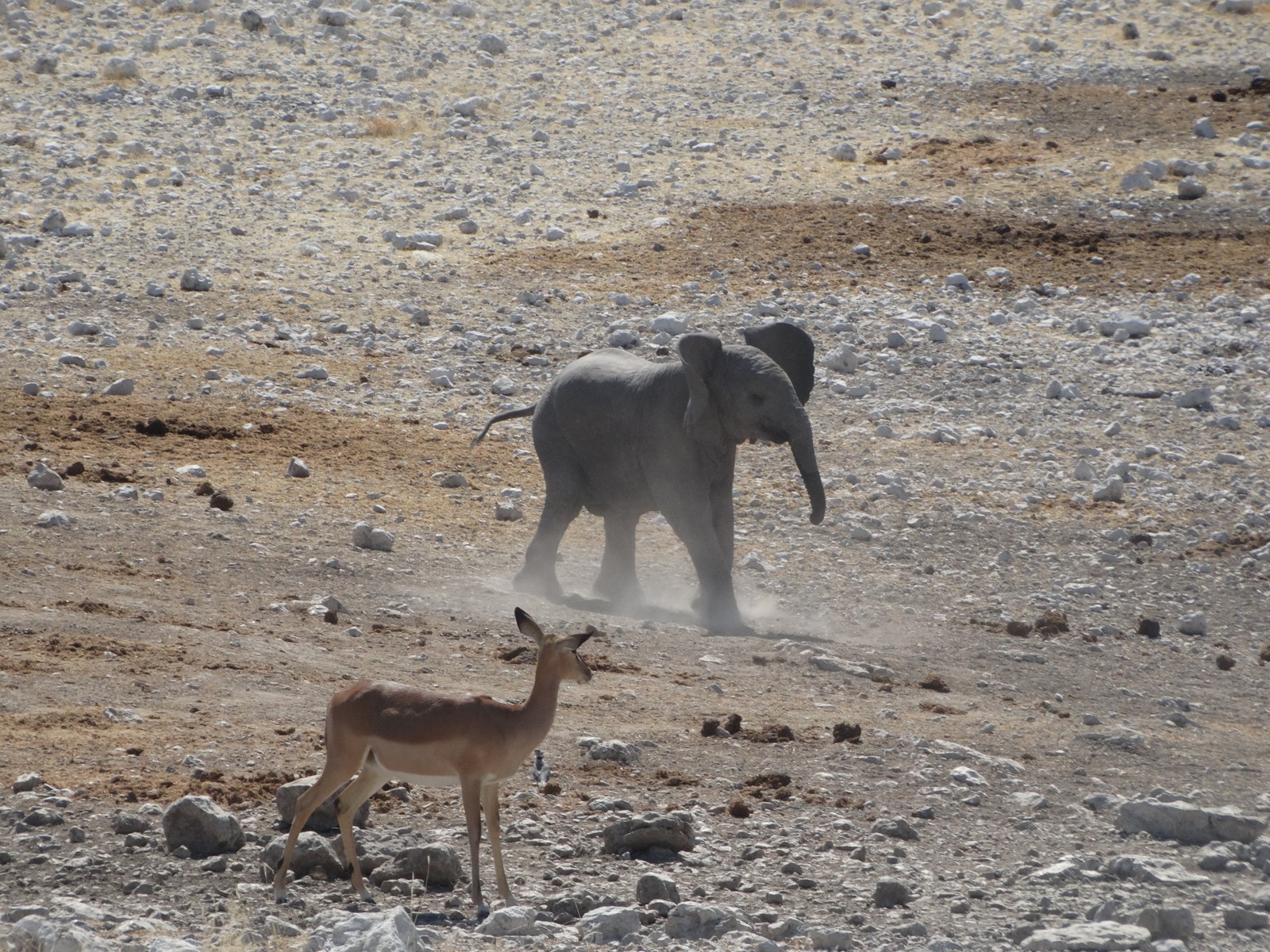
Image credit & rights
Baby elephant playing fake charge.jpg — Benoît Vicart, via Wikimedia Commons. CC0 1.0. Source: https://commons.wikimedia.org/wiki/File:Baby_elephant_playing_fake_charge.jpg. Licence: https://creativecommons.org/publicdomain/zero/1.0/. Resized for web; no scene content changed.

Official MEFT material lists wildlife including:
- elephant;
- black and white rhino;
- lion;
- giraffe;
- leopard;
- black-faced impala;
- eland;
- zebra;
- springbok;
- blue wildebeest;
- oryx; and
- Damara dik-dik.
More than 400 bird species have also been recorded.
But do not turn that into a shopping list.
You may see one species repeatedly and miss another completely.
That is not a failed safari.
Should you self-drive or book a guided drive?
Self-drive works well if
- you enjoy moving at your own pace;
- you are comfortable driving slowly for hours;
- you like deciding when to stop and wait; and
- you are prepared to learn as you go.
A guided drive becomes valuable if
- this is your first safari;
- you want help interpreting tracks and behaviour;
- you want the perspective of somebody who drives the park regularly; or
- you want access to guided morning, afternoon or night drives offered from park camps.
You do not have to choose only one.
Self-drive during the day and book one guided drive.
That is a very sensible first-timer combination.
Where should NamSpace help you stay?
Etosha should not be one giant accommodation search result.
The Stay experience should eventually filter by the part of the park the traveller actually needs:
- South / Andersson Gate
- Okaukuejo area
- Central / Halali
- East / Namutoni / Von Lindequist
- North / King Nehale
- West / Galton
- Inside park
- Outside park
- Camping
Each listing should make the actual gate distance visible where reliably known.
“Near Etosha” is not enough.
Five mistakes first-time visitors make
1. Staying only one night
You are giving wildlife one short window to cooperate.
2. Choosing accommodation by price without checking the gate
The cheap room can become expensive in driving time.
3. Driving continuously instead of waiting
More kilometres do not automatically create more sightings.
4. Chasing every reported lion
You can spend the whole day following yesterday’s information.
5. Planning the final afternoon right up to sunset
You still need to reach your camp or gate legally and safely.
The simplest Etosha strategy
If this is your first visit:
Come for at least three nights if you can.
Enter through the gate that fits the wider route.
Split your stay if you want to cross the park.
Use the dry season for the strongest classic waterhole experience.
Use the green season if birding and a different landscape matter more.
And when you reach a waterhole that feels promising:
stop driving.
Etosha does not need you to chase it.
Sometimes the park comes to you.
Continue planning
The Practical 14-Day Namibia Road Trip
Find Car & 4×4 Hire in Namibia
Last checked: 4 October 2026.
Park roads, detours, gate conditions, fees, camp operations, wildlife distribution and accommodation availability can change. Check current MEFT and Namibia Wildlife Resorts information for your travel dates before departure.
Sources and travel updates
Primary/current sources checked 4 October 2026:
- MEFT Etosha National Park: https://meft.gov.na/national-parks/etosha-national-park/217/
- MEFT park permit FAQ: https://www.meft.gov.na/frequently-asked-questions/what-are-the-entry-permit-requirements-for-the-various-parks-in-namibia-/136/
- NWR park terms/gate operation: https://www.nwr.com.na/online-reservation-terms-and-conditions/
- NWR Okaukuejo: https://www.nwr.com.na/resorts/okaukuejo-resort/
- NWR Halali: https://www.nwr.com.na/resorts/halali-resort/
- NTB northern region / Etosha season and gates: https://visitnamibia.com.na/2022/03/northern-region/
- NTB Galton route: https://visitnamibia.com.na/windhoek-to-galton-experience/
- MEFT tourist-road upgrade project: https://eia.meft.gov.na/web/projects/2464
- NWR phase-one detour map: https://www.nwr.com.na/icheephu/2025/04/Detour-layout-phase-1-Final-rev-2.pdf