
Namibia travel · NamSpace
The Practical 14-Day Namibia Road Trip: See More Without Spending Every Day in the Car
A practical two-week circuit through Windhoek, Sossusvlei, the coast, Damaraland and Etosha.
As an Amazon Associate I earn from qualifying purchases. This article contains optional Amazon links. Check delivery and the full cost before buying.
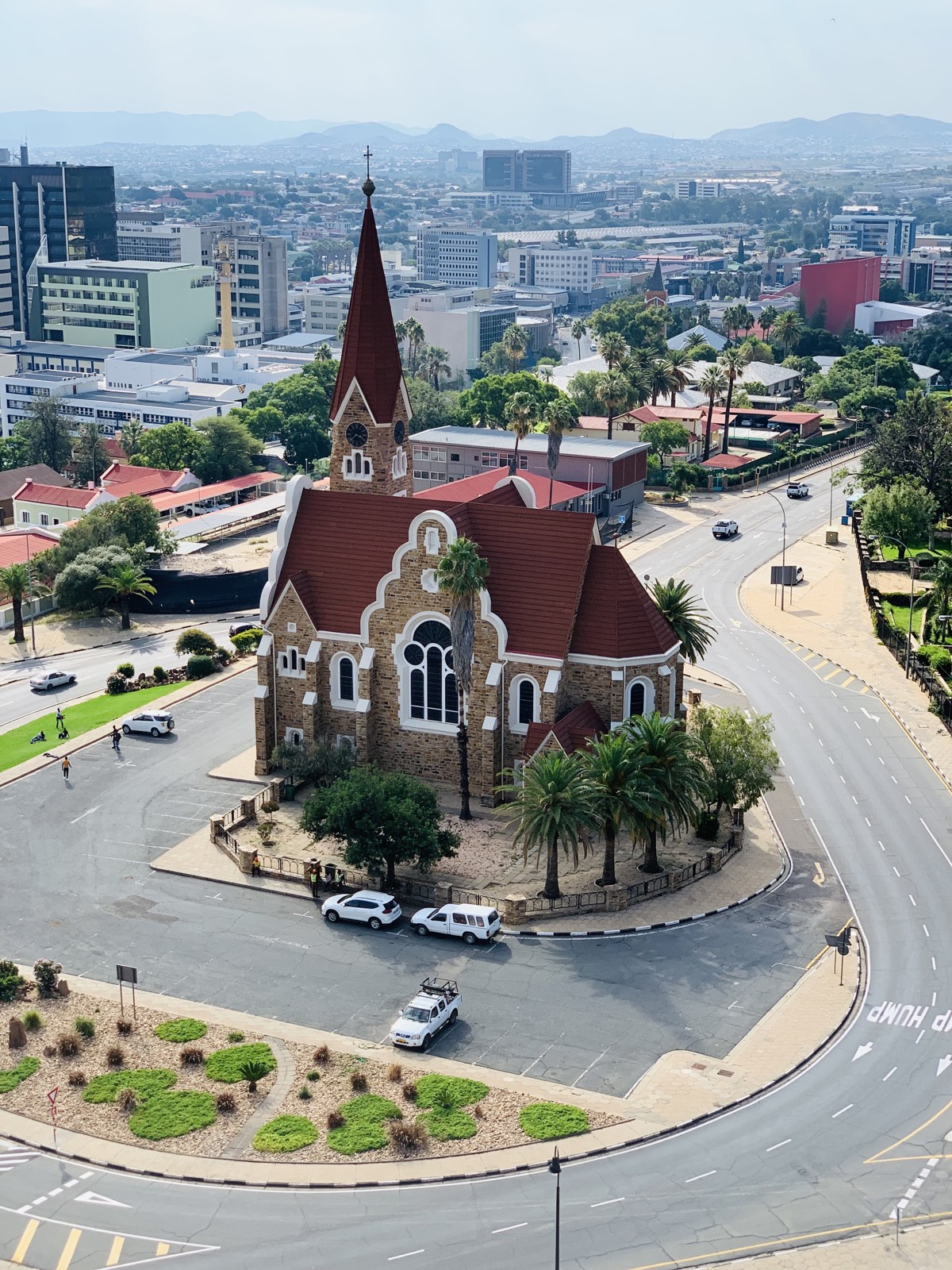
Image credit & rights
Windhoek Christuskirche Church.jpg — Gwasheya, via Wikimedia Commons. CC0 1.0. Source: https://commons.wikimedia.org/wiki/File:Windhoek_Christuskirche_Church.jpg. Licence: https://creativecommons.org/publicdomain/zero/1.0/. Resized for web; no scene content changed.

Last checked: 4 October 2026
Fourteen days sounds like a lot until you put Namibia on the map.
Windhoek. Sossusvlei. Swakopmund. Damaraland. Etosha. Rundu. Divundu. Zambezi. Fish River Canyon.
Suddenly two weeks starts looking very small.
The answer is not to drive faster.
It is to choose better.
This itinerary is built for a first Namibia road trip that still feels like a holiday. It gives you the desert, the Atlantic coast, the rock landscapes and cultural history of Damaraland, and several proper days in Etosha without turning every morning into another checkout and every afternoon into a race against sunset.
The route
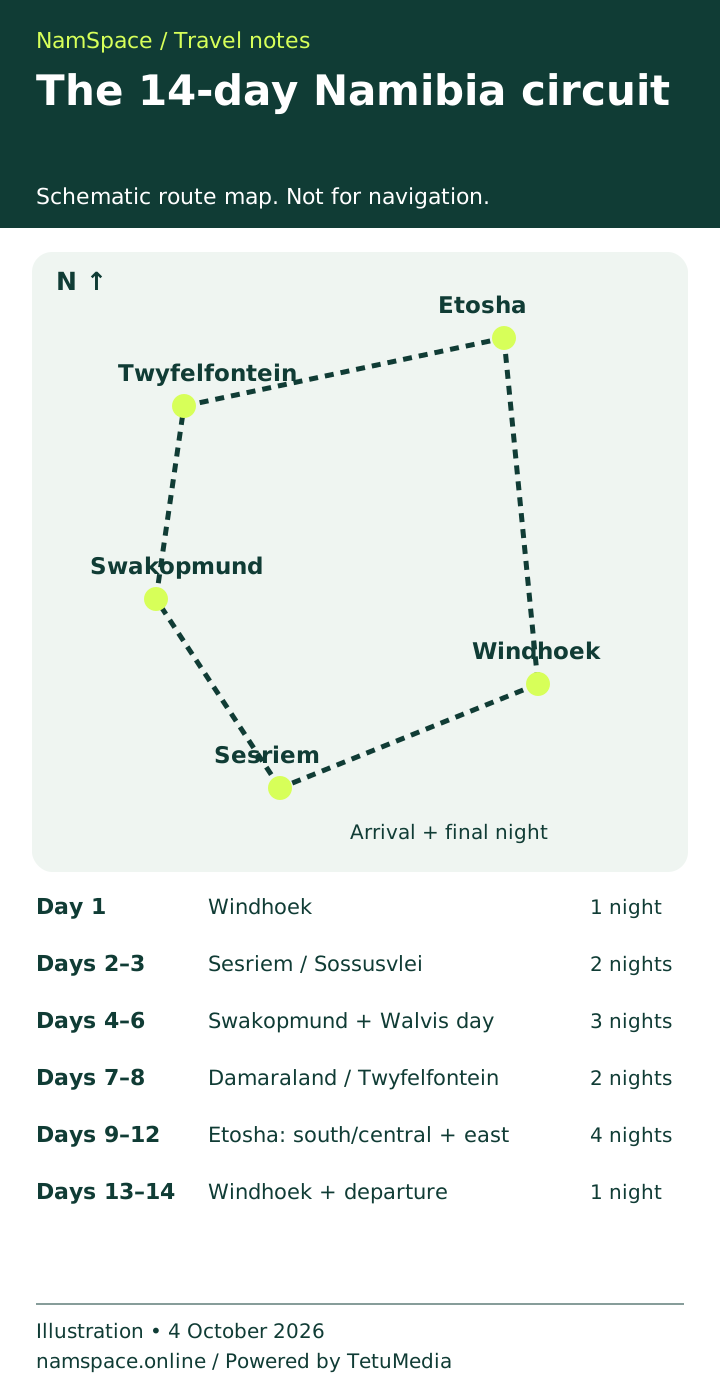
Image credit & rights
Illustration: NamSpace. Powered by TetuMedia.
Windhoek → Sesriem/Sossusvlei → Swakopmund/Walvis Bay → Damaraland/Twyfelfontein → Etosha → Windhoek
At a glance
| Day | Sleep | Main idea | Driving load |
|---|---|---|---|
| 1 | Windhoek | Arrive, recover, prepare | Low |
| 2 | Sesriem/Sossusvlei | Drive south-west into the Namib | Medium-high |
| 3 | Sesriem/Sossusvlei | Sossusvlei, Deadvlei, Sesriem Canyon | Low |
| 4 | Swakopmund | Cross the desert to the Atlantic | High but rewarding |
| 5 | Swakopmund | Coast, town, activities | Low |
| 6 | Swakopmund | Walvis Bay / coast / rest day | Low |
| 7 | Damaraland/Twyfelfontein | Head north into rocky desert country | Medium-high |
| 8 | Damaraland/Twyfelfontein | Rock art, landscapes, local experiences | Low |
| 9 | Etosha South | Enter the wildlife section of the trip | Medium |
| 10 | Etosha South/Central | Full game-viewing day | Low |
| 11 | Etosha East | Cross through the park slowly | Low-medium |
| 12 | Etosha East | Another full wildlife day | Low |
| 13 | Windhoek | Return to the capital | Medium-high |
| 14 | — | Departure | Low |
The point is not that every traveller must follow these exact stops.
The point is the rhythm:
drive → stay → experience → drive → stay.
Not:
drive → sleep → drive → sleep → drive.
Who this itinerary is for
This route works particularly well if:
- this is your first Namibia trip;
- you have around 13 nights / 14 days;
- you want a self-drive journey;
- Sossusvlei and Etosha are priorities;
- you want the coast without making it a one-night stop;
- you want at least one slower cultural/landscape section between coast and safari; and
- you would rather experience five regions properly than claim you visited nine.
It is not designed for somebody whose main objective is Kavango, Zambezi, the deep south or remote Kaokoland.
Those routes deserve their own itineraries.
Day 1 — Arrive in Windhoek and do less than you think you should
The instinct after landing can be to collect the car and immediately start driving.
You do not have to.
If you have travelled overnight or crossed several time zones, spend the first night in Windhoek.
Use the afternoon to:
- collect your vehicle;
- buy water and basic supplies;
- get a local SIM/eSIM sorted if needed;
- download offline maps;
- check the spare wheel and tools;
- ask the rental company about tyre pressure, gravel-road rules and emergency procedures; and
- eat something without watching the sunset disappear while you still have 180 km to drive.
The Namibia Tourism Board recommends allowing adequate time in self-drive itineraries because much of the country is gravel and travel is slower than the map can make it appear.
NamSpace connection
Find places to stay in Windhoek →
Find car & 4×4 hire in Namibia →
Day 2 — Windhoek to Sesriem / Sossusvlei
Planning this stop? Read Sossusvlei and Deadvlei for first-timers for accommodation location, stay length and final-access questions.
Today the road trip properly begins.
Leave Windhoek in the morning and head toward the Sesriem/Sossusvlei area.
Do not treat this as a transfer you need to finish as quickly as possible.
The landscape is already part of the trip.
Road conditions and the route you choose affect the day's timing, so leave enough daylight and avoid planning a late arrival.
By the time you reach Sesriem, the city should feel very far away.
That is the point.
Where to sleep
Stay in or around the Sesriem/Sossusvlei area for two nights.
Location matters here because the next morning is about getting into the desert early rather than spending the first hour driving from accommodation far away.
Day 3 — Sossusvlei and Deadvlei: give the desert the whole day
This is why you did not put Sossusvlei into a one-night stop.
Sesriem is the gateway to the major Sossusvlei and Deadvlei landscapes of Namib-Naukluft Park.
Start early.
The light is better, the temperatures are generally easier, and you have room to experience the place without immediately calculating how quickly you need to leave for the next town.
A sensible day can include:
- the drive toward Sossusvlei;
- Dune 45 or another dune experience;
- Deadvlei;
- Sossusvlei itself;
- Sesriem Canyon; and
- time back at your accommodation rather than another long-distance drive.
Namib-Naukluft Park includes Sossusvlei, Deadvlei and Sesriem among its signature desert attractions.
The mistake to avoid
Do not finish a full desert morning and then decide to drive all the way to Swakopmund because you want to "save a night".
You have fourteen days.
Use them.
Day 4 — Sesriem to Swakopmund
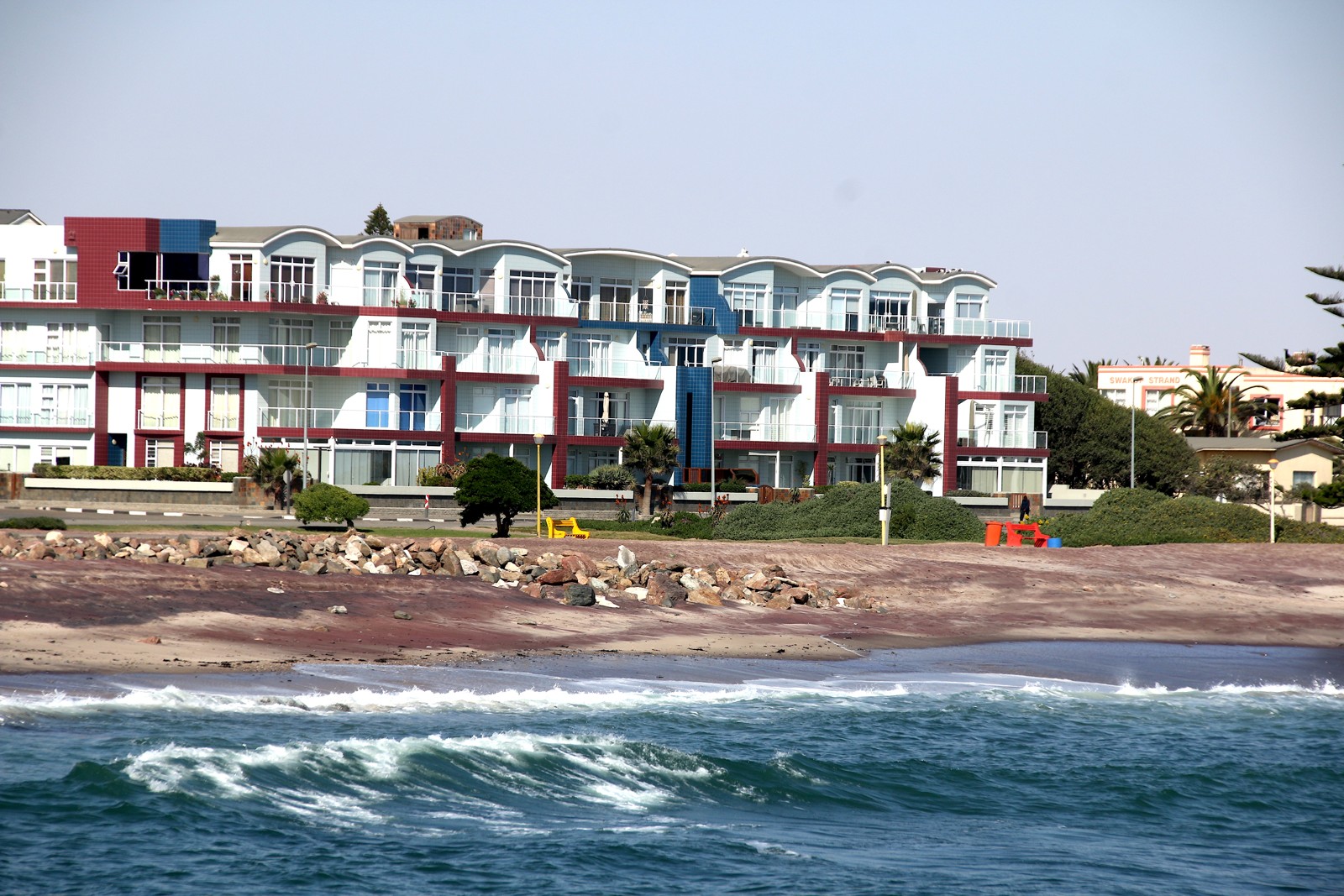
Image credit & rights
Swakopmund see from the Jetty.jpg — Hp.Baumeler, via Wikimedia Commons. CC BY-SA 4.0. Source: https://commons.wikimedia.org/wiki/File:Swakopmund_see_from_the_Jetty.jpg. Licence: https://creativecommons.org/licenses/by-sa/4.0/. Resized for web; no scene content changed.

This is one of the bigger driving days.
You are moving from the interior desert toward the Atlantic coast, and the change in landscape is part of what makes the route memorable.
Expect gravel and give yourself more time than the straight-line distance suggests.
Namibia Tourism Board advises self-drive travellers not to exceed 80 km/h on gravel and to build adequate time into itineraries.
Arriving in Swakopmund can feel strange after the desert.
Suddenly there are streets, cafés, restaurants, shops and cold Atlantic air.
You may also discover that the jacket you ignored in Windhoek now has a purpose.
Stay three nights
Yes, three.
Not because Swakopmund itself takes three days to "see".
Because the coast is a useful pause in a long road trip and gives you flexibility for activities, Walvis Bay and simple rest.
Day 5 — Swakopmund without another suitcase
Do not touch your luggage today.
Walk around.
Eat somewhere slowly.
Choose an activity if you want one.
The central coast offers desert excursions, marine activities, adventure experiences and an urban break between long interior driving sections.
Or do very little.
A road trip does not become better because every empty hour has been turned into a booking.
Day 6 — Walvis Bay, the coast or a genuine rest day
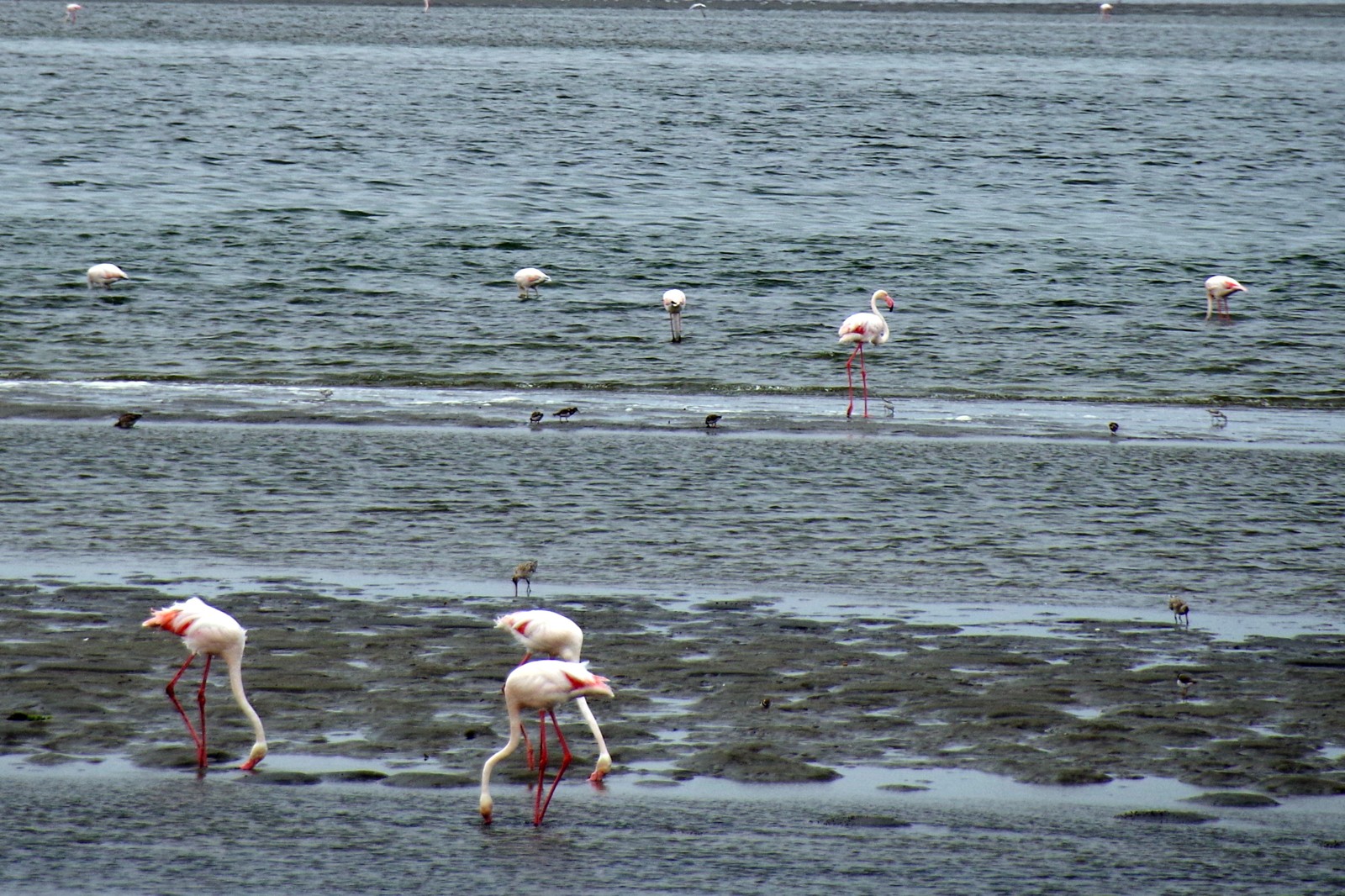
Image credit & rights
NA-walvisbay-lagoon-famingo.jpg — Balou46, via Wikimedia Commons. CC BY-SA 4.0. Source: https://commons.wikimedia.org/wiki/File:NA-walvisbay-lagoon-famingo.jpg. Licence: https://creativecommons.org/licenses/by-sa/4.0/. Resized for web; no scene content changed.

Walvis Bay is close enough to Swakopmund to explore without changing accommodation again.
Depending on your interests, this can be a lagoon/marine day, a guided desert experience, photography day or simply an extra coastal day.
For routes such as Sandwich Harbour, use an appropriate registered operator rather than assuming a normal rental vehicle and basic 4×4 confidence are enough.
This is also deliberately your buffer day.
If yesterday's activity was cancelled because of weather, you have room to move it.
If you are tired, you have room to rest.
That flexibility is valuable.
Day 7 — Swakopmund to Damaraland / Twyfelfontein
Now the road trip changes again.
You leave the coast and move north into the huge landscapes of Damaraland.
The Namibia Tourism Board's recognised route network links Swakopmund with Etosha through this north-western corridor and recommends several days for the broader journey rather than treating it as one transfer.
Depending on your chosen route and stops, places such as Uis, the Brandberg area and other north-western landscapes can form part of the day.
Fuel when you have the opportunity.
Carry water.
And remember that a scenic gravel road is still a gravel road.
Stay two nights
Again, this is deliberate.
Damaraland should not exist only as the road between Swakopmund and Etosha.
Day 8 — Twyfelfontein and Damaraland
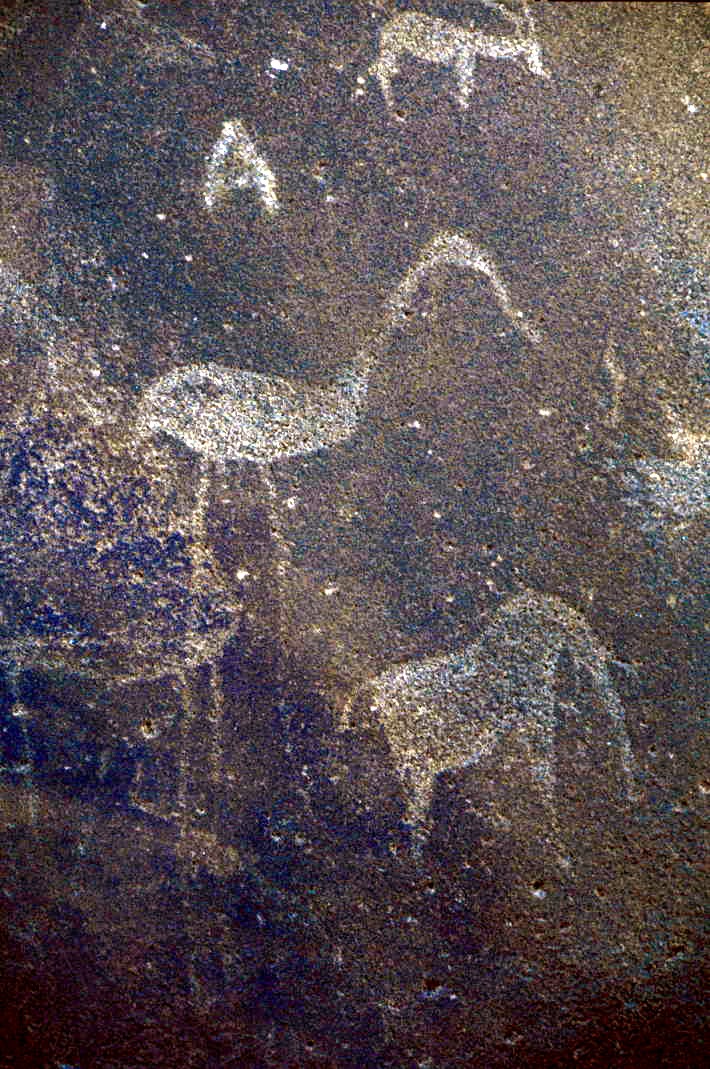
Image credit & rights
Twyfelfontein (2006) 08.jpg — LBM1948, via Wikimedia Commons. CC BY-SA 4.0. Source: https://commons.wikimedia.org/wiki/File:Twyfelfontein_(2006)_08.jpg. Licence: https://creativecommons.org/licenses/by-sa/4.0/. Resized for web; no scene content changed.

Twyfelfontein is Namibia's first UNESCO World Heritage Site and contains one of Africa's major concentrations of rock engravings.
The surrounding Damaraland landscape is also a destination in its own right: rocky mountains, broad plains, dry river systems and desert-adapted wildlife.
A day here could include:
- Twyfelfontein rock engravings;
- other geological/cultural sites in the area;
- a guided local experience;
- landscape photography; or
- a properly operated desert-adapted wildlife excursion where appropriate.
Do not chase desert elephants yourself because somebody dropped a pin in a WhatsApp group.
Use experienced local guides where the activity requires local knowledge and responsible wildlife behaviour.
Day 9 — Damaraland to Etosha South
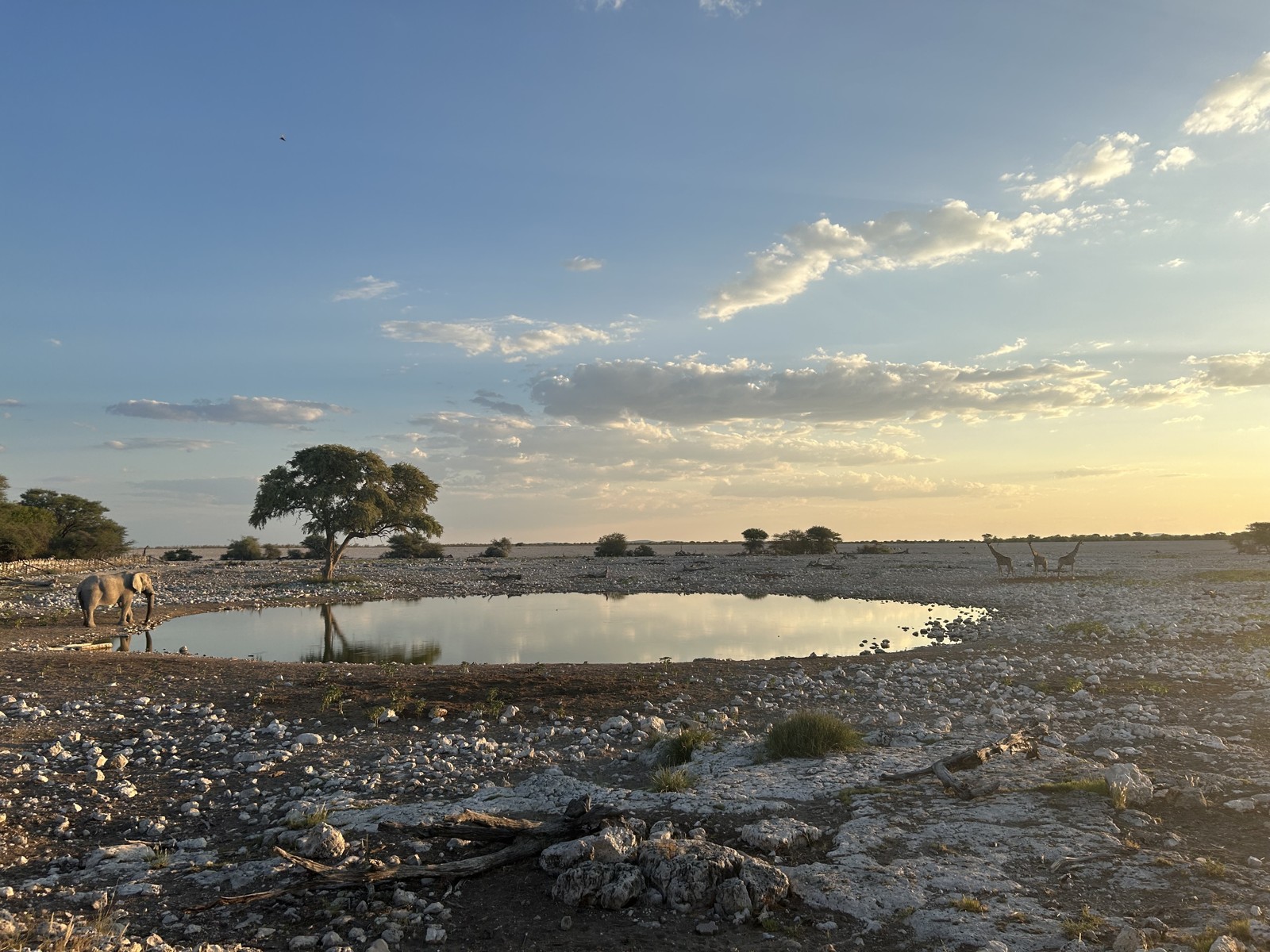
Image credit & rights
Waterhole Okaukuejo Camp in Etosha National Park.jpg — Hka1987, via Wikimedia Commons. CC0 1.0. Source: https://commons.wikimedia.org/wiki/File:Waterhole_Okaukuejo_Camp_in_Etosha_National_Park.jpg. Licence: https://creativecommons.org/publicdomain/zero/1.0/. Resized for web; no scene content changed.

Today the trip moves from rock landscapes into the safari section.
Head toward Etosha's southern side and settle near or inside the park depending on your accommodation plan.
Do not make your first Etosha day depend on arriving at the gate late in the afternoon.
Get there with daylight left.
Have a quiet evening.
Tomorrow is where Etosha gets your full attention.
Day 10 — Etosha: stop counting kilometres
Today the kilometre target is irrelevant.
You can drive surprisingly little and still spend the entire day out.
Etosha is Namibia's flagship national park and is known for its wildlife and network of waterholes.
Move slowly.
Wait.
Sometimes the best game-viewing decision is not to race toward the next sighting somebody told you about.
It is to stay where you are for another twenty minutes.
Two nights on the southern/central side works well
It means this day does not end with another cross-country relocation.
Day 11 — Cross Etosha gradually toward the east
Instead of leaving Etosha and driving around it on the highway, use today to move through the park toward the eastern side while game viewing.
This is a transfer day that does not need to feel like a transfer day.
Plan your accommodation and gate/camp strategy in advance because park rules, road conditions and access arrangements can change.
Keep your speed down and respect park rules.
If wildlife blocks the road, the wildlife wins.
Day 12 — Etosha again
Four nights around Etosha may look generous on a spreadsheet.
Once you are there, it probably will not.
Wildlife does not run on your itinerary.
Yesterday may have been extraordinary.
Or quiet.
That is exactly why another full day matters.
You can focus on a different part of the park, revisit productive waterholes or simply take the morning slower.
This is the advantage of not trying to insert six more destinations into the same trip.
Day 13 — Etosha to Windhoek
Now return to Windhoek.
This is a meaningful driving day, but much of the established route back toward the capital is straightforward compared with the gravel-heavy desert and north-west sections earlier in the trip.
Start early enough that you are not finishing the holiday with another night drive.
Use Windhoek for your final night rather than gambling an international departure on a long same-day drive from Etosha.
Return the vehicle if that suits your rental arrangement or keep it until departure.
Have dinner.
Do nothing complicated.
You have earned it.
Day 14 — Departure
Leave Namibia without having spent yesterday panicking about whether a puncture would make you miss the flight.
That small piece of buffer is good trip design.
Why Kavango and Zambezi are not in this itinerary
Because Namibia is big.
Rundu, Divundu, the Kavango River and Zambezi are not small add-ons north of Etosha.
They change the character of the journey completely.
The north-east deserves several days for river landscapes, wildlife, birding, communities and the long distances involved in getting there and back.
Trying to add Rundu or Katima Mulilo to this itinerary simply so you can say you went there would undermine the entire reason this route works.
Better idea
Make the north-east your second Namibia route, or extend this trip significantly beyond two weeks.
NamSpace already has Stay content around the Kavango, including Kayova River Lodge, and the broader Rundu-to-Divundu route is planned as its own travel guide.
Could you do this route in 10 days?
Yes.
But something has to give.
You would probably remove one or more of:
- the third Swakopmund night;
- one Damaraland night;
- one Etosha night; or
- the final Windhoek buffer.
That makes the trip possible.
It does not automatically make it better.
Could you stretch it to 21 days?
Absolutely.
That is where Namibia opens up.
With another week, you could:
- slow Damaraland down further;
- include Spitzkoppe or another intermediate stop;
- extend north-east toward Rundu and Divundu;
- add Waterberg;
- deepen the coast section; or
- simply stop moving so often.
The extra week should not automatically mean seven new destinations.
Sometimes it means keeping the same route and improving it.
What vehicle do you need for this route?
For the classic established version of this itinerary, a full expedition 4×4 is not automatically necessary.
Namibia Tourism Board guidance says established routes to major destinations including Sossusvlei, Swakopmund and Etosha can be reached using 2WD vehicles, while a higher-clearance vehicle or 4×4 adds flexibility and comfort for rougher or more remote routes.
Your exact accommodation access roads, season and detours still matter.
Choose the route first.
Then choose the vehicle.
Find car & 4×4 hire in Namibia →
Where should you stay?
The accommodation logic of this trip is as important as the road itself.
Windhoek
Choose convenience for arrival and departure.
Sossusvlei / Sesriem
Location matters because early access to the desert experience matters.
Swakopmund
Choose based on whether you want central walkability, coast views, self-catering or a quieter residential stay.
Damaraland
Choose based on the experience and route, not simply the cheapest room on the map.
Etosha
Choose your side of the park deliberately. South/central and east are not interchangeable if you want to reduce unnecessary driving.
Where to Stay in Namibia →
The five rules that make this itinerary work
1. Two nights means two nights
Do not keep cancelling the second night because another attraction appears on Instagram.
The whole point is to slow the route down.
2. Arrive before dark
Daylight is part of your travel budget.
3. Fuel before you are desperate
Especially before longer gravel and remote sections.
4. Do not turn wildlife into a checklist
Etosha does not owe you a lion before lunch.
5. Leave something for next time
Namibia is too large to finish.
That is not a problem.
The route in one sentence
Windhoek → two nights at Sossusvlei → three nights on the coast → two nights in Damaraland → four nights around Etosha → final night in Windhoek.
It gives you some of Namibia's biggest first-trip experiences while still leaving enough time to actually notice where you are.
That is the route I would choose over a longer list of destinations.
Continue planning
Find Car & 4×4 Hire in Namibia
Driving in Namibia: Gravel Roads, Fuel, Distances & 4x4s
Best Time to Visit Namibia: A Month-by-Month Guide
Getting your bag ready? Use our Namibia packing guide for a core list and additions by season and region.
Comparing the full trip cost? Read Namibia on a Budget for complete quotes, route choices and a worked planning example.
Making room for north-eastern Namibia? Read Rundu to Divundu: A Kavango River Road Trip for community-led culture, river stays and a suggested four-night itinerary.
Continuing into Zambezi? Read our Zambezi Region Travel Guide for river time, cultural visits, park choices and a suggested five-night itinerary.
Sources and travel updates
Last checked: 4 October 2026.
Primary reference anchors:
- Namibia Tourism Board transportation/self-drive guidance
- Namibia Tourism Board Namib-Naukluft Park / Sossusvlei guidance
- Namibia Tourism Board Damaraland and Twyfelfontein guidance
- Namibia Tourism Board Arid Eden / Swakopmund-to-Etosha routes
- Namibia Tourism Board Etosha National Park guidance
- Ministry of Environment, Forestry and Tourism park notices
- Namibia Wildlife Resorts for current in-park accommodation/resort references
Driving times, park conditions, roadworks, opening arrangements and accommodation availability can change. Travellers should confirm current conditions shortly before departure.